What Is a Technology Strategy?
Modern organizations depend on technology not just to operate, but to compete. Customer expectations, remote work, automation, cybersecurity risks, and data-driven decision-making have fundamentally changed how businesses function. As a result, companies can no longer treat technology as a support function alone, it has become a central driver of growth and innovation.
Yet many organizations still invest in tools reactively, adopting software or platforms to solve immediate problems without considering long-term implications. This often leads to fragmented systems, rising costs, and operational inefficiencies.
A technology strategy solves this problem by providing a structured, forward-looking plan that connects technology investments directly to business outcomes.
Technology Strategy Definition
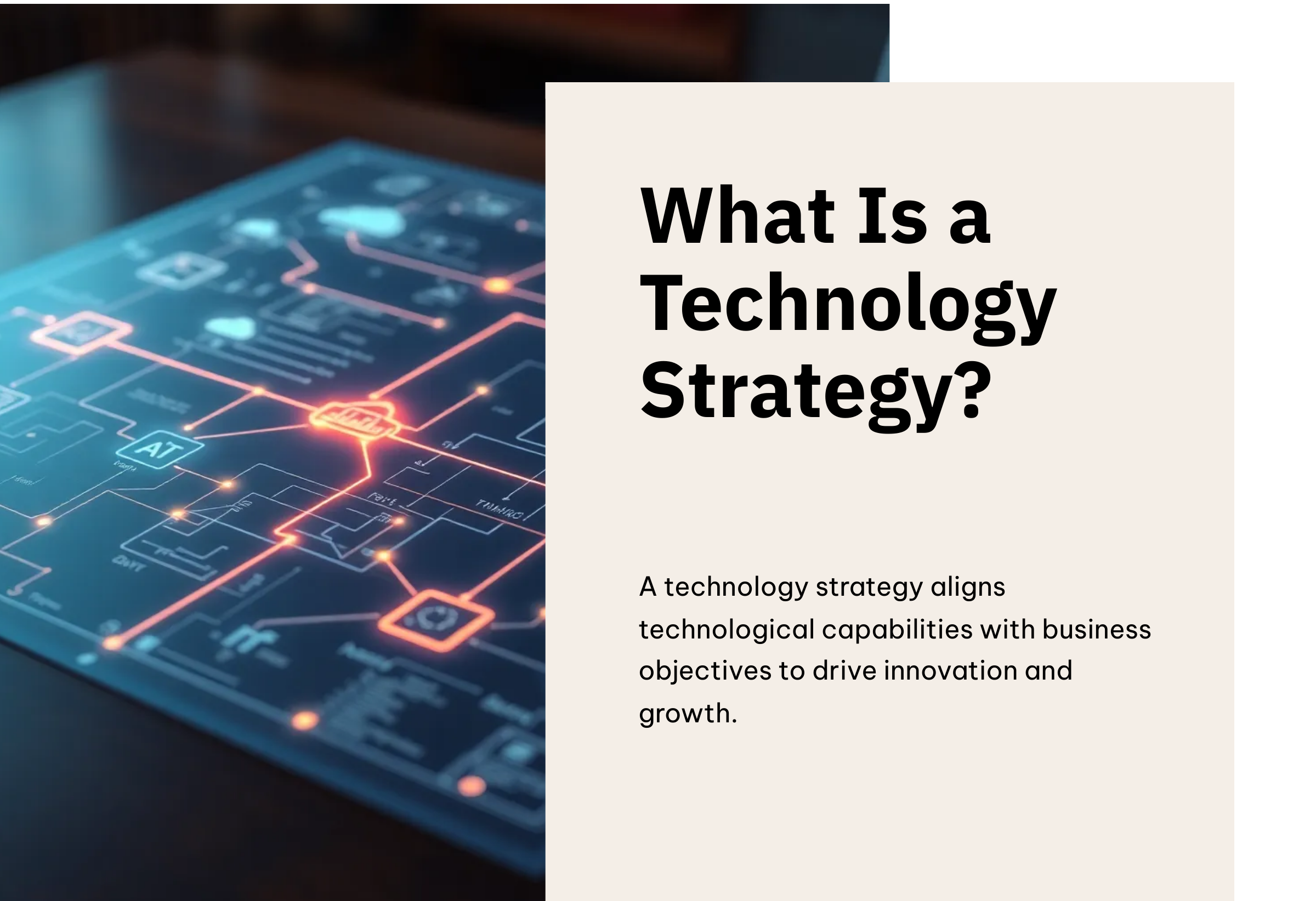
A technology strategy is a long-term plan that defines how an organization will use technology to achieve its business objectives now and in the future.
A technology strategy determines what technology a company invests in, how those technologies work together, and how they help the business grow, compete, and operate more effectively.
It answers critical questions such as:
- Which technologies should we adopt, and which should we avoid?
- How do systems integrate across departments?
- How do technology decisions support revenue, efficiency, and customer experience?
- How do we remain adaptable as technology evolves?
A technology strategy is not a list of software purchases or an IT upgrade schedule. Instead, it serves as a decision-making framework that guides every technology-related investment.
Why Technology Strategy Matters More Than Ever
Technology environments have grown increasingly complex. Organizations now manage cloud platforms, SaaS tools, cybersecurity systems, analytics solutions, collaboration platforms, and automation technologies simultaneously.
Without a strategic approach, companies commonly experience:
- Tool duplication across departments
- Data silos preventing insights
- Escalating subscription costs
- Security vulnerabilities
- Slow innovation cycles
A well-defined technology strategy transforms technology from a cost center into a competitive advantage.
Key Business Benefits
- Aligns technology investments with measurable business goals
- Prevents unnecessary or redundant software spending
- Improves operational efficiency and workflow automation
- Enables faster innovation and product development
- Enhances cybersecurity and compliance readiness
- Supports scalable growth without constant system replacement
- Improves employee productivity through integrated tools
Organizations with strong technology strategies tend to make fewer reactive decisions and achieve better long-term ROI from technology investments.
Technology Strategy vs IT Strategy
Although often used interchangeably, these concepts operate at different levels of organizational planning.
| Aspect | Technology Strategy | IT Strategy |
| Strategic Focus | Business transformation through technology | Operational management of IT systems |
| Organizational Scope | Entire company | IT department |
| Leadership Ownership | Executive leadership + technology leaders | CIO/IT leadership |
| Decision Orientation | Future-focused and innovation-driven | Reliability and efficiency-focused |
| Time Horizon | Long-term (3–5+ years) | Medium-term operational planning |
| Primary Goal | Competitive advantage | Stable infrastructure |
In short:
- Technology strategy asks: How does technology help us win as a business?
- IT strategy asks: How do we maintain and operate systems effectively?
Both are necessary, but technology strategy provides the higher-level direction.
The Full Scope of a Technology Strategy
A comprehensive technology strategy extends across nearly every organizational function. It defines how technology supports both daily operations and long-term transformation.
Business Alignment
Technology decisions must begin with business priorities.
Key considerations include:
- Revenue growth objectives
- Market expansion plans
- Customer experience improvements
- Operational efficiency targets
Technology should enable strategy, not dictate it.
Infrastructure and Architecture
This area defines the technical foundation supporting all systems.
Typical decisions include:
- Cloud-first vs hybrid infrastructure
- Platform standardization
- System scalability planning
- Integration architecture
- Performance and reliability requirements
Poor infrastructure planning often leads to costly re-platforming later.
Data and Analytics Strategy
Data has become one of the most valuable organizational assets.
A technology strategy establishes:
- Data ownership and governance policies
- Data integration across systems
- Analytics and reporting capabilities
- Real-time decision-support tools
- Data quality standards
Organizations with unified data environments make faster, more informed decisions.
Cybersecurity and Risk Management
Security is no longer optional but instead foundational.
Technology strategy addresses:
- Risk assessment frameworks
- Identity and access management
- Data protection standards
- Compliance requirements
- Incident response planning
Embedding security into strategy prevents costly retroactive fixes.
Application and Software Ecosystem
Most companies operate dozens, sometimes hundreds, of applications.
A strategic approach defines:
- Approved platforms and vendors
- Integration requirements
- Lifecycle management policies
- Buy vs build decisions
- Vendor risk evaluation
This prevents uncontrolled software sprawl.
Innovation and Emerging Technology
Technology strategy prepares organizations for future opportunities.
Areas commonly evaluated:
- Artificial intelligence and automation
- Advanced analytics
- Digital products or services
- Customer personalization technologies
- Industry-specific innovation trends
The goal is structured experimentation rather than trend chasing.
Workforce Enablement and Skills
Technology adoption succeeds only when people can use it effectively.
Strategic planning includes:
- Workforce training programs
- Collaboration and productivity tools
- Change management frameworks
- Talent acquisition and reskilling
Technology strategy is as much about people as platforms.
Core Components of an Effective Technology Strategy
A strong strategy document typically contains several interconnected elements.
| Component | Purpose | Business Value |
| Vision Statement | Defines future technology direction | Aligns leadership |
| Current-State Assessment | Identifies strengths and gaps | Prevents blind investments |
| Guiding Principles | Establishes decision rules | Ensures consistency |
| Target Architecture | Describes future systems environment | Enables scalability |
| Technology Roadmap | Prioritized initiatives over time | Improves execution |
| Governance Model | Defines accountability | Reduces decision delays |
| Investment Framework | Guides budgeting priorities | Maximizes ROI |
| KPIs & Metrics | Measures outcomes | Demonstrates value |
How Technology Strategy Drives Business Growth
Technology strategy directly influences an organization’s ability to compete and adapt.
Operational Growth
- Automates repetitive processes
- Reduces manual errors
- Improves cross-department coordination
Customer Growth
- Enables personalized digital experiences
- Improves response speed and service quality
- Supports omnichannel engagement
Financial Growth
- Optimizes technology spending
- Reduces maintenance costs
- Improves forecasting accuracy through analytics
Strategic Growth
- Accelerates entry into new markets
- Enables scalable product launches
- Supports mergers and acquisitions integration
Common Technology Strategy Mistakes
Even well-intentioned organizations can undermine strategy execution.
Frequent Pitfalls
- Treating technology planning as an IT-only exercise
- Choosing tools before defining business goals
- Ignoring employee adoption challenges
- Over-customizing systems unnecessarily
- Underestimating integration complexity
- Measuring success only by cost reduction
- Failing to revisit strategy regularly
A successful strategy balances innovation with operational practicality.
Technology Strategy Development Process
Creating a technology strategy is a structured, collaborative process.
Step-by-Step Framework
| Step | Objective | Key Output |
| Define Business Goals | Clarify organizational priorities | Strategic objectives |
| Assess Current Environment | Evaluate systems and costs | Technology audit |
| Identify Capability Gaps | Find barriers to growth | Gap analysis |
| Establish Principles | Define decision standards | Governance guidelines |
| Design Future State | Plan target architecture | Technology blueprint |
| Build Roadmap | Sequence initiatives | Implementation timeline |
| Implement Governance | Assign ownership | Decision framework |
| Measure & Optimize | Track performance | KPI reporting |
Technology Strategy Example
| Business Goal | Technology Initiative | Operational Impact | Expected Outcome |
| Improve customer experience | Unified CRM implementation | Centralized customer data | Higher retention |
| Reduce operational costs | Workflow automation | Less manual processing | Lower expenses |
| Support remote workforce | Cloud collaboration platforms | Real-time communication | Increased productivity |
| Enable data-driven decisions | Enterprise analytics platform | Cross-system reporting | Better forecasting |
| Strengthen security | Zero-trust security framework | Controlled access | Reduced risk exposure |
Who Owns a Technology Strategy?
Ownership is shared across leadership because technology affects every department.
Primary Stakeholders
- Executive leadership (CEO, COO)
- CIO or CTO
- Operations leaders
- Finance teams
- Security and compliance officer
- Product and innovation teams
- HR and workforce development leaders
Cross-functional ownership ensures technology decisions reflect real operational needs.
Signs Your Organization Needs a Technology Strategy
Many businesses recognize the need only after problems emerge.
Common indicators include:
- Departments using disconnected tools
- Increasing software costs without performance gains
- Frequent integration failures
- Slow implementation of new initiatives
- Security incidents or compliance concerns
- Difficulty scaling operations
- Employees frustrated with inefficient systems
These symptoms usually signal strategic misalignment rather than technical failure.
Long-Term Impact of a Strong Technology Strategy
Organizations that invest in strategic planning gain structural advantages:
- Faster innovation cycles
- Greater organizational agility
- Improved resilience during disruption
- More predictable technology costs
- Stronger competitive positioning
Technology becomes a growth enabler instead of a reactive expense.
Why Technology Strategy Is a Business Essential
Understanding the technology strategy definition is essential for modern organizations navigating rapid digital change. A well-developed technology strategy connects vision, operations, and innovation into a cohesive plan that guides every technology investment.
Rather than chasing trends or reacting to immediate challenges, organizations with a clear strategy build adaptable systems, empower employees, and create sustainable competitive advantages, turning technology into one of their most powerful business assets.
Technology Strategy FAQs
1. What is the simple technology strategy definition?
A technology strategy is a long-term plan describing how an organization uses technology to achieve business goals and create competitive advantage.
2. Is a technology strategy only for large enterprises?
No. Smaller companies often benefit more because early planning prevents costly scaling problems later.
3. How is technology strategy different from digital transformation?
Digital transformation refers to modernization initiatives, while technology strategy provides the long-term framework guiding those initiatives.
4. Who should develop a technology strategy?
Executive leadership, business stakeholders, and technology leaders should collaborate to ensure alignment.
5. How often should a technology strategy be updated?
Most organizations review annually and adjust quarterly as business priorities evolve.
6. Does a technology strategy include cybersecurity planning?
Yes. Security and risk management are core strategic considerations, not separate activities.
7. What is a technology roadmap?
A roadmap outlines prioritized technology initiatives, timelines, budgets, and expected outcomes.
8. How long does it take to build a technology strategy?
Typically 6–12 weeks depending on organizational size and complexity.
9. Can companies copy another organization’s technology strategy?
No. Strategies must reflect unique business models, goals, and operational environments.
10. What happens if a company operates without a technology strategy?
Organizations often face rising costs, fragmented systems, security risks, and slower growth due to reactive decision-making.
Shadow AI: Risks, Detection and an Enterprise Policy
AI Governance Regulations and Rules for Enterprise Businesses
Technology Strategy vs Digital Transformation: What’s the Difference and Why It Matters
Technology Strategy vs Digital Transformation: What’s the Difference and Why It Matters Organizations today rely heavily on technology to compete, innovate, and serve customers. As a result, two concepts frequently appear in business discussions: technology strategy...
Palantir’s stock is winning over Wall Street. Another analyst just turned bullish.
**Palantir Technologies: Analyzing the Recent Market Selloff and Its Implications for AI Leadership** In recent weeks, Palantir Technologies has experienced a significant and, according to some analysts, “unjustifiable” selloff in its stock price. This downturn has...
The surprising reason why the U.S. economy is growing so fast
**Corporate Spending Set to Propel U.S. Economic Growth for Fifth Consecutive Year** As the U.S. economy continues to navigate the complexities of a post-pandemic landscape, corporate spending is emerging as a significant driver of growth, positioning the nation for...